Showing posts with label smartphone. Show all posts

Thursday, November 21, 2013

Mobile Banking Popular Among Smart Phone Users

According to the "Mobile Money Study" published last month by Data Innovation Network almost 70% of US smartphone users had used at least one mobile banking and/or payment service on their phone in the previous three months.

As has been found in previous studies and reinforced by Doug Brown from Bank of America at last year's BAI Retail Delivery Conference in Boston, the Mobile Money Study found that checking account balances was the most popular banking application (82%) followed by looking for posted transactions (62%). Account alert features were also popular (46%), with roughly 40% of those surveyed transferring money between accounts.


Interestingly, an overwhelming majority of smartphone users accessed mobile banking using their mobile browser (66%) as opposed to a mobile app (20%), with a large number of respondents interested in a mobile wallet concept where they could swipe their phone like a credit or debit card. This possibility was also found to be popular with a Gen Y panel when I attended last year's BAI Transpay Conference in San Diego.

As the penetration of smartphones continues to increase, consumers will become more and more comfortable with and demanding of mobile banking services. I expect the availability and ease of use of mobile banking to become a significant competitive differentiator in the coming 12-18 months for financial institutions.

Monday, November 4, 2013

Siri: My Bank 2.0 Concierge

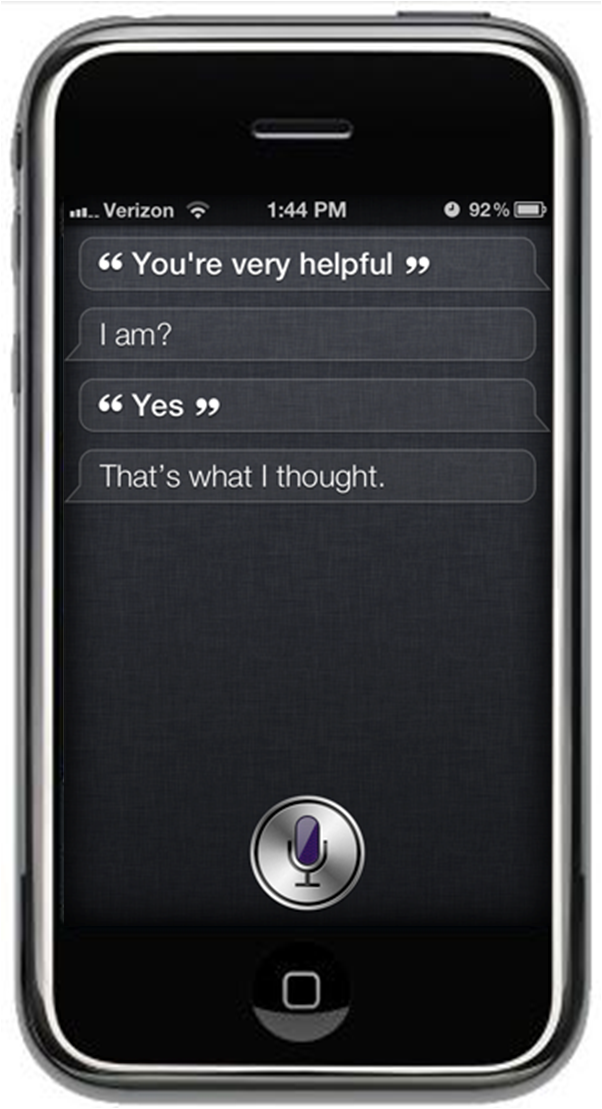
The introduction of Siri as the star feature of the new iPhone 4S already appears to be setting the stage for a major change in the way people interact with their phones. By combining insight reminiscent of IBM super computer Watson and the voice of a willing assistant, marketers from all industries can leverage this technology to simplify the way we complete tasks with voice commands. There is no doubt that Siri's introduction represents the mainstreaming of voice recognition and natural language interface in much the same way that the introduction of the iPad mainstreamed tablet computing.

Siri represents something of a paradigm shift in how we will interact with mobile devices going forward, and there are few places where this movement from keystroke to voice command will impact business more than banking. While today's voice technology in banking does fairly well in being able to recognize basic transaction commands and process rudimentary transactions, leveraging the technology and humanized tone of Siri and similar programs will allow banks to process an endless array of interactions seamlessly from the convenience of the phone.

Much like you would use a hotel concierge to ask various local-themed questions, imagine a world where my future banking concierge based on Siri technology will be able to work on my behalf and answer questions such as:
  • Where is the closest ATM where I won't have to pay a fee?
  • Where is the nearest restaurant with an NFC enabled payment device?
  • Please transfer $600 into my checking account from my money market account and make my mortgage payment at XYZ bank.
  • When will the most recent deposits I made clear?
  • Are there any merchant-funded reward offers that I am eligible for at Southfield Mall?
  • Where is the closest branch with Saturday hours (assuming I would ever need to visit a branch)
What is nice is that my future banking concierge would process all of my questions with the pleasant nature of my current GPS system, listening intently and not getting frustrated if my question seems trivial or repetitive. In fact, the intelligence behind applications like Siri would get more intelligent over time and evolve based on my behavior. And instead of receiving a link, search box, application or an ad, I will receive a verbal confirmation or a direct answer.

Leading banking organizations will most likely also find a way to allow me to open a new account without ever picking up a pen, typing in personal information or meeting a new account representative face-to-face. By taking insight already available within my mobile applications and various social media sites I use, my banking concierge could easily fulfill the requirements for establishing a new account whenever I desired. This capability will obviously hasten the potential reduction of vast branch networks.

While Siri only works with the iPhone 4S, alternative voice recognition applications like Vlingo (available on Android as well as iOS devices) and Nuance (which recently acquired Swype) will definitely benefit from the re-introduction of Siri by Apple as well. In fact, last week, Boston-based Vlingo saw activations increase by 50% daily, according to GigaOm at a time when usage overall has skyrocketed.

Source: PC Magazine, October 17, 2011
The key to success of Siri and other voice applications is the natural language interface, or the ability to add context to words spoken that enable the application to figure out what the user wants to do. That requires a semantic engine and artificial intelligence that continually gets better over time. In the banking world, however, the combination of transactional processes and questions are comparatively simple. In addition, with the heightened competition for the best interface, the capabilities of these systems will continuously improve while the investment needed to leverage these capabilities will become less.

Do you think Siri and related applications will be integrated into banking by legacy financial organizations? Will the integration be fast enough to fend off the new entrants into the industry such as BankSimple and MovenBank or even current online banking providers such as Ally?

I would love to hear your opinion.

Wednesday, October 30, 2013

The Impact of the iPhone 5 on Bank Marketing


So, the anticipation is over and the newest version of the iPhone has been introduced. When all was said and done, there were few surprises left as to what the iPhone 5 would offer, and for those of us who were crossing our fingers for the possibility of NFC integration (and further payments disruption), there may have even been a bit of disappointment.

And while additional enhancements to the Passbook app provides a glimpse into the potential for a head on competition with Google Wallet for payments supremacy in the future, the shop-with-your-phone coupon capability is not applicable to most bank marketers. What should be of more importance to bank marketers is the additional marketing real estate provided with the new phone and the growth in sales that may be on the horizon.

Bank marketers should see promise with the iPhone 5's larger, 4-inch screen with Retina display which provides 18% more pixels for delivering enhanced mobile ads, banners, landing pages and interactive campaigns. While the extra pixels may not seem like much, it moves the iPhone experience closer to that of the iPad, which has already proven itself to be a major tool for consumer consumption. And for those who are still tablet-less, it is possible that this new device will a bridge for engaged behavior.


According to Rachel Pasqua, vice president of mobile at digital agency iCrossing, "the enlarged iPhone is enough to make mobile creative a little more eye catching and get more users more deeply engaged." She mentioned that there will also be less potential for mis-clicks leading to better potential interaction. The potential for greater speed through the LTE and the new iOS6 also will help.

Charles Golvin from Forrester Research noted in a recent post that while other competitors already offer a larger canvas in some cases, "Apple still outpaces the competition when it comes to the entire package -- the new iPhone unites significant improvements in industrial design, imaging, audio and connectivity, along with the wealth of new capabilities that iOS6 enables."

The key for bank marketers is that iPhone 5 users, and smartphone users overall, will be spending more time with content on their phone. It is therefore important to provide the level of content that optimizes both the customer experience and marketing potential of the new devices. Consumers are no longer content with static web pages and difficult to use links and landing pages. Content (web pages, banners, ads, landing pages, etc.) will need to be easier to interact with and be more dynamic. 

There is no way of knowing how popular the new iPhone 5 will be in the marketplace, but if the past is any indication of the future, not only will many current iPhone users upgrade to the new model, but the overall iPhone penetration will increase as well. As shown below, nearly 2 in 5 of the 38.2 million Americans using iPhones are on the iPhone 4, which was released just 2 years ago. More impressive than that is the fact that 35% of iPhone users today are on the iPhone 4S, which was introduced less than 12 months ago.


Just as with the tablet, bank marketers should realize that simply 'super sizing' a current app or website is no longer enough from the customer's perspective. It is important to leverage the tools and advancements that are available with the newest generation of phones. 

And even though our industry does not have products that are as visually appealing as in retail and other industries, the challenge to differentiate our offerings may be greater, but the opportunity is still significant. 

Tuesday, October 29, 2013

Monetizing Mobile Banking


As consumers are becoming more comfortable with mobile banking and mobile payments, financial institutions and technology providers are beginning to develop and deploy more innovative solutions with a focus on gaining market share, reducing costs and realizing new sources of revenue. It is clear that the question is no longer whether mobile banking and mobile payments will be important to a bank's business (84% of respondents to a recent KPMG survey said that it is). The question has become, can banks realize the full potential of the channel from a customer development and revenue perspective.

To this end, one of the best sessions I attended last week at the BAI Retail Delivery Conference was around the opportunity for banks to monetize mobile banking. Presented by Matt Wilcox, senior vice president of eBusiness strategy for Zions Bancorporation and Drew Sievers, CEO of mFoundry, the session focused on the opportunity for mobile banking to move from simply reducing costs to actually being the foundation for revenue generation. 

Mobile Banking Evolution

At the beginning of the presentation, Wilcox presented an overview of the mobile banking evolution that has occurred over the past several years. According to Wilcox, mobile banking has evolved from being simply a channel innovation to providing the potential for significant channel migration cost savings as shown below. He noted, however, that banks should not build business cases around 1:1 transaction displacement, since many consumers increase their overall transaction volume as they move to more automated channels. This is similar to what occurred with ATM volumes that increased at a much higher rate than branch transactions decreased in the past.

Source: TowerGroup and Fiserv (2010)
Wilcox also provided a look at the differences in profitability and attrition that has been attributed to mobile channel engagement at Zions Bank. As shown below, customers with both an online and mobile banking relationship generated close to 30 percent more revenues than an online customer, while having an attrition rate that was more than 60% lower. 

Source: Zions Bank

While Carl Tsukahara, CMO from Monitise stated in another BAI session that, "the wallet wars will be over in the next two years and that banks need to get off the sideline", Drew Sievers emphasized that banks still are in an extremely strong position relative to other players. According to Sievers, "Banks control the key elements of funds, identity and authentication. In addition, banks have consumer trust and millions of pieces of software on mobile phones, positioning themselves strongly in the mobile wallet market."

Mobile Revenue Potential

This session continued with Matt and Drew discussing the significant revenue potential of mobile banking. The potential was put in context of mFoundry's new mobile banking platform (Fin.X), that provides banks a choice of mobile apps from a Service Provider Network of 30+ companies including FISDieboldDwollaMicronotes and Blackhawk Network. According to the presenters, there are 14 categories of revenue that banks can leverage in the future, including more traditional sources such as bill pay, mobile deposit, PFM and security services along with less traditional features such as expedited payments, credit scoring, gift card issuance, insurance quotes and even integrated retail bar-code scanning and bank product cross-selling.


Based on preliminary estimates, close to $100/customer annually can be generated mobile enhancements as shown below. According to Wilcox, "I believe services such as expedited payments take a proven model and revenue stream and make it more convenient on the mobile banking app. In addition, many of the other revenue streams place a value on customer convenience and integrate products that the customer already purchases through other channels such as gift cards, insurance, etc. I think we have only scratched the surface here." Sievers added, "Integrated services like those provided through Fin.X have the potential to transform mobile banking into an institution's most profitable channel."
      • Bill Pay: $20
      • Online Account Opening: $15
      • Merchant-Funder Rewards/Offers: $15
      • Enhanced P2P: $6
      • Credit Scoring: $8
      • Gift Card Issuance: $12
      • Insurance quotes/Referral Revenue: $15
      • Cross-Selling: $7
Initial mFoundry Fin.X Partnerships

The following is a sampling of partnerships announced last week my mFoundry to be included in their Fin.X cloud-based partnership solution.

Blackhawk Network: Will offer digital and physical gift cards from hundreds of brand name merchants to smartphone users which can later be redeemed electronically.

Micronotes: Will deliver individually tailored and actionable promotions to a customer's smartphone using big data analytics and customer insight improving relevance, timing and offer delivery. 

WAUSAU Financial Systems: Will provide the convenience of mobile remote deposit capture (RDC) capabilities using WAUSAU’s Deposit 24/7 Mobile™ functionality. Institutions can choose from two additional providers of mobile RDC solutions as part of the Fin.X solution.


Dwolla: While mFoundry is already recognized as the company powering the biggest and most successful mobile payments program to date, Starbucks Card Mobile, this partnership allows for a low-cost P2P money transfer service and a real time alternative to ACH payments which can take 2-3 days.

Diebold: Will allow users to scan a Quick Response code on the ATM and enter an authentication code to initiate withdrawals and deposits without a card. The smartphone will be used as an authentication device, reducing the security risk associated with lost cards, stolen cards and skimming. 


"With mFoundry's new service, banks and credit unions can select as many, or as few, extensions as they want", according to Sievers. "We will be adding new partners into the ecosystem in order to create an even larger and richer offering."

Untapped Opportunity

The key to monetizing mobile banking is to aggressively move people from traditional channels to mobile. I asked Wilcox how banks should encourage customers to use the mobile channel when many banks have had limited success moving beyond getting early adopters to engage? According to Matt, he believes getting clients to handle their balance checking on the mobile device is still a huge initial opportunity that will build engagement over time. "Moving clients from the IVR or contact center to the mobile device is still a great opportunity", he stated. "I also believe banks have an opportunity to engage clients within mobile by removing the tie to online banking. We are only now seeing banks decoupling these services, with those banks doing so realizing a larger growth in adoption."


Sievers added, "The future of mobile banking is how you generate more revenue for the financial institution. It's not only about saving money since mobile banking pays for itself. It's about making the channel a revenue generating tool."


Additional Insights

Saturday, October 26, 2013

From Passbook to Mobile: The Evolution Of The Bank Account


"Some might argue that nothing replaces a face-to-face relationship. That assumes that a digital, mobile experience is inferior to face-to-face. And while that may have been true in the past, that's not going to be the case in the future. Welcome to the total disruption of retail banking".


By Brett King, Bestselling author of Bank 3.0 and founder and CEO of Movenbank.


In 2009, I was visiting the head of retail for a major retail banking brand headquartered in Asia, and with a growing presence in the Middle East. This was 2 years after Apple's phenomenal launch of the iPhone, and by this time the iTunes store already had close to 100,000 apps and had surpassed a billion downloads. 

People were clamoring to get the iPhone, with unlocked 'grey market' phones available everywhere you looked in Hong Kong, Dubai, Shanghai and Singapore, because to that point, Apple had not launched the iPhone anywhere outside of countries like the U.S. But sitting in this executive's office, you'd never realize it.

I spoke about the impact that mobile and social media was having on consumer behavior, and how dominant apps would become in respect to the way consumers would do their banking over the next 3-5 years. I discussed the breakout success of Bank of America, the first bank in the US to launch mobile banking, with millions already using the bank's app daily to access their bank (and with 10,000 mobile users currently being added each day). 

This executive didn't buy my message. They insisted that nothing they were seeing was showing a shift in behavior. If anything, they believed the branch was getting stronger and the Gen-Y segment was just like any other demographic.
Within 3 years, this bank would be in serious trouble with their mobile positioning. Well behind the competition on the mobile and social front, shrinking acquisition statistics and lagging cross-sell results on the retail side would all be early warning signals that this bank was not only out of touch, but that their entire historical business model was under threat.

This was not an isolated experience. In 2009, just 3% of all banks in the US had mobile banking propositions. And, while the number of banks with mobile has increased to 80% of the 100 banks today, as an industry in flux we just can’t afford to wait 5-6 years before technologies like mobile are widely adopted. 

Today, we see tablet computing growing at 3 times the rate the iPhone grew in its first 3 years. Through the success of phones like the Samsung Galaxy III and others, Android smartphones are now growing at 6 times the rate the iPhone did during it’s early dominance of the industry. 

The problem facing the banking industry is that this technology shift is really only just getting started. What comes next is going to change the way we do banking forever. How can I make that claim?

Prior to the launch of the iPhone we’d never even heard of apps, and yet today, just four and a half years later, here are a few of the phenomenal stats in relation to mobile computing platforms like the iPhone, iPad and Android phones:

        • 1,000,000 Apps for Apple and close to 700,000 for Android[1]
        • Approaching 50 billion downloads for Apple, and already 25 billion for Google Play (previously known as the Android Marketplace)
        • Daily downloads 48.6 million per day - Apple

In the past, it might take years for new technologies like the first PCs, Mobile Phones (Feature Phones) or even Internet adoption to become mass market and to have an impact on the way we do business. Today, new technologies such as the iPad and new interaction platforms like Facebook and Instagram are being adopted by consumers en masse in a period measuring just months.

To illustrate that this change is speeding up, here’s a great stat from Apple. In 2011 alone, Apple sold more iOS devices than all the Macs it had ever sold in the 28 years prior.

“This 55m [iPads sold to-date] is something no one would have guessed. Including us. To put it in context, it took us 22 years to sell 55 million Macs. It took us about 5 years to sell 22 million iPods, and it took us about 3 years to sell that many iPhones. And so, this thing is, as you said, it’s on a trajectory that’s off the charts…”  -Tim Cook, Apple CEO during February 2012 reporting call

In Q1 of 2012, Apple then went on to sell more iPhone 4S devices than in the entire preceding 12 months. Samsung has recently done even better with the Galaxy SIII smartphone.

The reality is that over the next 3-5 years, mobile will not only continue to dominate changes in retail positioning and consumer behavior, but will become increasingly accessible to all parts of the economy. 
By the end of 2014, smartphone adoption is expected to reach 80% of the population in markets like the US, UK, Australia, Singapore, Hong Kong, UAE, and other developed economies. But this is not limited to developed economies and the mass affluent or middle and upper-class.

By 2016, low-end smartphones will cost less than $20, and Gilder’s Law dictates that basic Internet access will come bundled in your monthly plan at no additional cost. Today, Internet access via mobile devices has already surpassed wired internet access[2]. Put these trends together, and by the end of the decade, 80-90% of the world’s population will have access to the Internet via a smartphone.

This adoption of mobile will fundamentally change how retail banking and payments work in our economy going forward.

Subscribe to Bank Marketing Strategies

For 60% of the world’s population that today does not have a bank account, their mobile phone will likely be their very first banking experience. In markets like Kenya and the Philippines, the majority of the population has had their first electronic payments experience via their phone, and their first deposit account was simply a balance carried on their phone. 

The fastest growing use cases for mobile in emerging markets like these have been payments and remittances. In markets like Kenya, this has changed the day-to-day flow of cash in the economy. The same will soon be true for India, China, Indonesia and other such emerging markets.

By 2020, the world’s bank account will be indistinguishable from the functionality you find on your mobile phone. Your mobile device will allow you access to your money (in the form of an available balance), send and receive money, pay at a store, pay online and to exist fluidly in the world of commerce. 

In the past, we have tended to characterize our bank account by its physical form factor. Initially, a passbook was our ‘bank account’. Then in the 80s, the checking account was the primary form of banking relationship. Today, our debit card (attached to an online account number) is how most of us do our day-to-day banking. Very soon, however, banking will be dominated by the mobile phone.

2013 will be a big year for mobile payments. Many of the mobile wallet projects currently in development will hit the market. The first mobile-only banks, such as Movenbank, will go live with products and interactions designed for an enhanced customer experience around the mobile device. ISYS will launch, and other players like Google Wallet, PayPal and Square will duke it out for merchant dominance in mobile payments space. 

NFC deployment will start to be highly visible, and more banks will announce PayPass and v.Me (Visa) deployments to capitalize on this emerging mobile trend. When we look back on 2013, we’ll recognize it as the year the biggest players realized that mobile was the game changer it was projected to be.

By 2015-16, mobile banking use will dominate day-to-day banking interactions in most developed economies, being the preferred channel for the majority of customers. This is unlikely to have a significant impact on Internet banking utilization, however, since tablet computing will still be widely used for managing day-to-day portfolios, bill payments and transfers. In fact, comfort levels with digital interactions will rise such that consumers will manage most of their banking relationships entirely through digital devices, with more than 60% of retail banking revenue coming through non-human channels. 

This mobilization of banking will put extraordinary pressure on branch systems. Initially, many banks will move to reduce their branch network by up to 20-30%, retooling and retasking remaining branches to focus purely on sales and service as transactional activity moves digitally. Branches that remain will either be brand flagship and showcase stores, or smaller footprint stores designed to support sales and service metrics without the large network expense. 

Financial analysts watching bank stocks will start to discount retail banking brands who aren’t aggressively dealing with excess capacity in the branch network. For the first time, we’ll see stock markets penalize banks for having branches.

Mobile has been consistently underestimated in terms of its impact on retail banking since the emergence of the “app” phone. The lack of enthusiasm and adaptation by major banking players, and the over reliance on traditional physical distribution, is opening up many doors for new non-bank players to own emerging banking and payments experiences on the mobile device. 

With the certainty that mobile will dominate the future of banking, it’s clear that banking won’t look much like it looks today in a decade’s time. It’s also clear that bankers like the one I mentioned at the start of the post, may very well be casualties of this disruptive change.


About the Author

Brett King is the bestselling author of 'Bank 3.0: Why Banking Is No Longer Somewhere You Go, But Something You Do' and the founder and CEO of New York-based Movenbank, the world's first direct mobile-only retail bank. King was voted American Banker's BTN Innovator of the Year for 2012 and is a strategic advisor on the future of financial services to clients like HSBC, Citigroup, Commercial Bank, UBS and Emirates NBD.


Additional Resources


Two Big Predictions: Banking 4 Tomorrow (January 2013)

The Future Of Banking Is All About Context: American Banker (January 14, 2013)

Bank of America Is Adding 10,000 Mew Mobile Users Each Day: Bank Innovation (January 2013)


References


Subscribe to Bank Marketing Strategy Via Email


Delivered by FeedBurner

Wednesday, October 23, 2013

Building A Winning Mobile Banking Strategy

Mobile banking has moved quickly beyond being simply online banking using a smartphone. It is at the hub of the customer relationship and is quickly becoming a point of differentiation and a potential source of revenue for progressive banks.


As smartphone penetration continues to increase, so do consumer expectations. To keep up, banks need to continuously review the best mobile banking strategies worldwide, developing those solutions that address customer needs and leverage the benefits of the channel.


To assist banks with the development and implementation of a successful mobile banking strategy, Forrester Research is developing a 12 chapter Mobile Banking Strategy Playbook. Within this playbook, extensive research is being compiled around marketplace assessment, mobile strategy development, optimal organizational structures, technology selection, best practices, measurement benchmarks and ways to continuously improve the mobile banking experience.


As part of the review of mobile banking best practices, Forrester just released their 2013 Global Mobile Banking Functionality Rankings (with U.S. and U.K. breakout reports) ranking the mobile offerings from 15 of the largest banking organizations in the U.S., Canada and abroad.

While only ranking some of the largest banking organizations worldwide, this research is invaluable to any bank wanting to see what the best in our industry are doing. Beyond rankings, this research also provides extensive examples of innovative mobile banking apps and advanced functionality (Purchase report here).

Subscribe to Bank Marketing Strategies

Organizations were judged on the following:

          • Range of touchpoints (devices and platforms supported)
          • The enrollment and login process
          • Account information and money management capabilities
          • Transactional features
          • Service features
          • Cross channel functionality
          • Sales and acquisition capabilities
          • Overall usability

While no firm is the best in every category, the evaluations provide insight into the strategic challenges and opportunities available to banks of any size.

Of the banks evaluated, Chase mobile banking was ranked the highest overall with a score of 71 out of 100, while Spain's la Caixa come in second with a score of 67 (the average score of all major banks evaluated was 56 out of 100). Chase's transactional functionality was highly regarded as was la Caixa's native mobile and tablet apps across all four of the major operating systems.

Overall, the large banks evaluated scored best on the range of touchpoints and account information, but poorly on sales and service features that are important to customers.

Peter Wannemacher, analyst for Forrester, says, "The most obvious missed opportunity among the 15 banks reviewed is that few are making effective use of context to make information more relevant to customers. Sales is another big missed opportunity, with many banks not even trying to cross-sell products and services through the mobile channel."

One of the key findings was that, while there are definitely examples of successful mobile banking implementations, far too many banks are not doing much more than meeting the basic needs of the consumer, rolling out apps and features without a clear assessment of where customer expectations and business objectives align.

In fact, even though some of the larger banks were lauded for new applications and functionality, the industry as a whole still seems to be missing the mark in the eyes of the consumer (as referenced in the Feb. 7, 2013 Bank Marketing Strategy post entitled, 'Banks Not Meeting Mobile Banking Customer Expectations').

Best-In-Class Functionality


In evaluating the major global banks, the Forrester reports not only provided a benchmark for the current state of mobile banking functionality, but uncovered many 'best practice' examples in each category reviewed which directly impacted enrollment, use, engagement and revenue potential.

Supporting Mobile Touchpoints

With the range of mobile platforms increasing, it is important for banks to be able to provide support across all touchpoints (optimizing for size and shape of unit) and across alternative delivery methods, including two-way SMS banking, dedicated mobile website, downloadable phone apps and tablet apps.

While it may seem that everything is moving to either downloadable smartphone or tablet banking apps, there are still many reasons to support SMS banking, including alerts or even the initiation of bill payments or transfers via an SMS (as is done by la Caixa). Oh yeah, and not everyone has a smartphone yet, therefore requiring support of basic mobile features through SMS text banking.

The offering of dedicated tablet mobile banking capabilities has definitely lagged behind smartphone applications but provides greater promise in many ways due to the added functionality and preferable demographics of tablet users. While more and more banks have developed apps for the Android tablet and iPad, far fewer support either the Windows or Kindle platforms.

RBC Tablet Banking App With Digital Advice and In-App Video (Forrester, 2013)

Encouraging Mobile Banking Enrollment and Use

Thank goodness for early adopters. Despite roadblocks and painful enrollment processes that were significantly more challenging than for online banking, smartphone devotees have found a way to sign up for mobile banking and use the service. To move beyond moderate levels of adoption and use, however, will require simplified enrollment and ease of use. 

Forrester believes one of the biggest impediments to enrollment today is that many banks still require mobile banking customers to have an online banking relationship. This requirement obviously limits mobile banking growth to only a subset of online banking customers as opposed to allowing all customers to benefit from mobile banking. Citibank was noted as one of a growing number of banks no longer requiring online banking for a mobile relationship.

GoBank Balance Bar
Surprisingly, Forrester also found very few banks that let customers enroll for mobile banking using their mobile phones. This is obviously counter intuitive from the customer's perspective. Wannemacher suggests, "Digital banking teams should build processes that let customers enroll through as many channels as possible, including ATMs, branches, call centers, mobile and online." In addition, he suggests the elimination of any 'validation period' before a customer can access their account.

Once a customer is enrolled, some banks need to reconsider the process of requiring separate online and mobile credentials or multiple authentications. For instance, my GoBank account allows me to authorize the viewing of balances without entering my login credentials. In addition to seeing my balance without a complete login, GoBank also allows me to enter my mobile banking account with only a password (as opposed to multiple login credentials).

If a bank is going to require multifactor authentication, it is recommended that a consistent sign-in process be used for both the online and mobile banking relationships. This is currently being done by many large banks including Bank of America, Wells Fargo and PNC Bank.

Finally, it is important to have a bank's entire front line and customer service team familiar with the mobile banking platform and trained to answer questions from a perspective of having used the service themselves. Some banks have even provided incentives to employees for conducting customer training sessions.

Enhanced Account Insight and Money Management

Most banks get the basics right, from providing balances to allowing access to previous transaction history. The differences come in providing more than the 'basics' from a customer experience perspective. As mentioned above, a bank can differentiate itself by the ease of getting account balances. Interestingly, only a few banks currently allow histories as far back as 90 days, with Bank of America being the only institution reviewed that allowed searches by keywords.

The real area of growth recently has been with the overlay of Personal Financial Management (PFM) tools within the mobile banking platform. Built internally or purchased from a variety of outside providers, the ability to provide visual interpretations of a person's financial health and ability to provide budgeting tools is exciting. 

One of the foremost providers of this type of functionality is MobileDesktop who was reviewed last Fall by Bank Marketing Strategy. Their mobile solutions provide easy to understand tools that can help make mobile banking the hub of a customer's financial relationship.

Expanded Transactional Functionality

Being able to perform transaction easily, using a smartphone, is the key to customer mobile engagement. The more a customer can do using their phone, and the more contextual interaction that can occur, the less likely the customer on the go will leave your bank. For instance, while doing internal transfers between accounts was rated relatively high for every U.S. bank (except HSBC that has no transfer capabilities), most U.S. banks make it much more difficult to transfer to funds to another bank.

In evaluating bill payments, Chase was recognized for being able to add a new payee directly from a mobile device, while U.S. Bank has just recently introduced the ability to pay bills by taking a photo of the bill itself. Chase and Citibank were also recognized for their P2P payment functionality, while there are several organizations in other countries (CommBank Kaching) that have moved beyond the requirement of a phone number and/or email address to allow payments via a Facebook connection.

More exciting may be the possibility to view transactions and the impact on budget immediately using a smartphone as is being done with the new start-up Moven. With this enhancement, customers will not only know what they spent and where, but how much they have spent at a specific location or purchase category in a given month as the purchase is being made. This will allow customers to make informed decisions before making a purchase as opposed to looking in the financial rear view mirror.

Mobile Service Accessibility

According to Wannemacher from Forrester, "As mobile banking becomes the primary way to conduct business for many customers, they will expect to be able to access a growing number of service-related tasks from within their mobile banking application." As the only criteria that all of the 15 banks in the study failed, it was believed that the ability to use a search capability for basic information or transactions using a mobile device was important.

Additionally, it was believed that customer assistance should be available instantly through the mobile device. In my own experience, even the more recent banks to enter the mobile competitive marketplace find this capability difficult to provide. In fact, none of the new banks, like GoBank or Simple provide a tool to get assistance immediately like Wells Fargo does through a Twitter link. For example, in multiple tests, Simple required as much as 24 hours to respond to a basic service question.

All of the banks reviewed provided some amount of balance, transaction or security alerts with varying degrees of customization. While some banks allow set-up directly from the mobile device, others require sign-up and structuring via the online banking application.

Cross-Channel Integration

While being able to access customer support directly from the mobile app a great example of cross-channel support, there are other ways for all of a customer's interactions with a bank to be integrated. Interestingly, while almost all of the banks reviewed by Forrester provided phone numbers for customer service, none provided instant chat, IM or a direct link for phone support.

One of the more dynamic ways to integrate channels is the way U.S. Bank, PNC and others are helping customer locate ATMs through an augmented reality functionality, providing a street level view of where branches and ATMs are located. This functionality is a great example of how the geolocational capabilities of a mobile device can provide benefits to both a customer and the bank. In the future, the availability of merchant-funded rewards could also be communicated in this manner.

Finally, the integration of social media within a bank's mobile banking application is being done much more extensively overseas than in the U.S. according to Forrester. Probably none do as much integration with social media like Facebook and Twitter as Commonwealth Bank of Australia. Not only do they show live tweets in real time on their mobile banking platform, but their integration with Facebook and YouTube content is one of the strongest in the industry. In fact, CommBank has recently added Kaching for Facebook as an extension of their traditional mobile banking product lineup.


Marketing and Cross-Selling Through Mobile

As mentioned at the beginning of this post, banks have yet to fully utilize the potential of the mobile banking channel for the marketing of additional services the way they have leveraged the online banking channel. While there are spacial and time limitations on what marketing can be done on a smartphone or tablet compared to a computer screen, potential still remains that is untapped.

U.S. banks did very poorly compared to their counterparts overseas, with virtually no marketing being done via mobile, with the exception of some brand reinforcement and banner adds by Wells Fargo. Potentially cautious about impacting the transactional focus of most mobile banking functions, U.S. banks have yet to leverage the massive amount of contextual insight available with a mobile device.

Forrester found Commonwealth Bank of Australia again to be one of the most advanced organizations from a perspective of marketing via the mobile platform, with Bank of America being recognized for what is beginning to occur with the availability of merchant funded rewards through the mobile device.


Promoting Mobile Banking


We are at the tipping point between the acceptance of mobile banking by early adopters and the potential of the mass market (some may say we have passed this stage). As a result, banks must begin to promote mobile banking to a wider audience using messaging that appeals to those consumers who don't understand the benefits of the channel.

Forrester research recommends the following mobile banking marketing strategies:
          • Integrate mobile banking within all brand marketing campaigns
          • Rather than promote mobile banking generically, promote individual functions and features ('there's an app for that')
          • Leverage target marketing opportunities to segments such as frequent users of online banking, bill pay, heavy ATM users and/or customers who frequently do balance inquiries
          • Leverage traditional media such as POS, ATM messaging, direct mail, email to support targeted efforts
          • Use social media like Facebook and gamification to promote mobile banking
          • Leverage video within the mobile banking site to explain the benefits of mobile banking and ways to use the service that are unique to the channel
          • Encourage current mobile banking users to recommend services to friends and family
          • Help customers overcome security concerns with guarantees
          • Provide interactive devices in branches that can demonstrate how mobile banking works
          • Fully explain all costs involved
          • Provide incentives for enrollment and use


Why Does This Matter?


As the penetration of smartphones increases, customer expectations are increasing as well. As more innovative applications are developed within and outside the financial services sector, the ability for banks to keep pace becomes both more difficult and more important. 

Online banking already seems to be hitting a threshold of acceptance, with some consumers skipping over this stage of financial engagement and moving directly to mobile banking. With the growth in tablet use, consumers are able to access highly graphic and sophisticated financial planning tools on the road or while multi-tasking in their home. New devices and new tools provide an increased level of engagement and contextual interaction to those banks that seize the opportunity.

While most banks already offer some mobile banking functionality, the challenge going forward will be to execute a strategy that is a differentiator both from a customer experience and revenue perspective. By building an agile, best-in-class mobile infrastructure, the impact can be realized through increased differentiation, lower cost customer acquisition, improved channel efficiency, enhanced customer retention, and greater revenues through cross-selling and up-selling of products and services and through merchant-funded rewards.

By executing and optimizing a successful mobile banking strategy that is integrated with a wider multi-channel strategy, banks will be better positioned for the future of both mobile banking as well as mobile payments.

According to Peter Wannemacher from Forrester, "Before rolling out more standalone mobile apps, digital banking leaders need to lay out a vision for how mobile will change the way their bank sells and serves its customers. With this in mind, digital banking in the future must be simple, ubiquitous, personal, empowering and most importantly, reassuring."

Additional Resources

2013 Global Mobile Banking Functionality Rankings: Forrester Research (April 2013)

2013 U.S. Mobile Banking Functionality Rankings: Forrester Research (April 2013)

Can You Bank On Your Banking App?: Varolii Corporation (February 2013)

2013 U.K. Mobile Banking Functionality Rankings: Forrester Research (April 2013)

The Mobile Banking Imperative: Forrester Research (November 2012)

Best Practices in Mobile Banking: Forrester Research (January 2013)

Mobile Banking: Financial Services Meet The Electronic Wallet: Free Ebook from Knowledge@Wharton and Ernst & Young (2013)

The Mobile Banking Strategy Playbook: Forrester Research

A  More Mobile Future For Banking: American Banker (March 1, 2013)